
Communications
Being clear in your communication can save time and prevent unnecessary stress on you and your family.
Things to consider
- A family/group chat to keep all relevant people informed of updates (e.g. via WhatsApp)
- A dedicated email address (e.g. [email protected]) to point the public/media to
- Make sure any public profiles/inboxes are being regularly checked
- Unknowns invite speculation, which can be unhelpful and hurtful – try to stick to facts
Public vs private
Deciphering which details are relevant to the police and to the public (they can differ), is something you should decide on as a family. Only discuss potentially sensitive details with trusted sources, and be consistent with what information you’re sharing publicly.
Dealing with the disappearance of a loved one is incredibly difficult and it’s normal to feel as if you’re oscillating between hopefulness and hopelessness. To inspire action and engagement, try to keep your public narrative positive (e.g. staying hopeful that your loved one will be found, thanking the community for their support). Private narratives might be quite different (e.g. disappointment with police, concerns they might not ever be found), and can be shared in safe spaces, like with trusted friends, family and mental health professionals.
Storing your information
You will find that you need to give people the same information over and over again. It is a good idea to keep everything in one place for easy access. Dropbox, Google Drive or OneDrive are all good options. If you aren’t confident with the technology, get help from someone who is.
These tools let you store and share high-resolution images, video, spreadsheets, press releases etc.
Sharing assets (with media/volunteers/the public)
- Avoid sensitive personal information that could put the missing person or your family at risk.
- Create a public folder/s and share the link with those who may need high-resolution material (e.g. photos, videos, posters).
- Set the folder so files can be viewed and downloaded but not edited or deleted.
- Only include materials you are comfortable sharing publicly (be mindful to edit out/blur images of others featured/named or get consent where applicable).
Written appeals
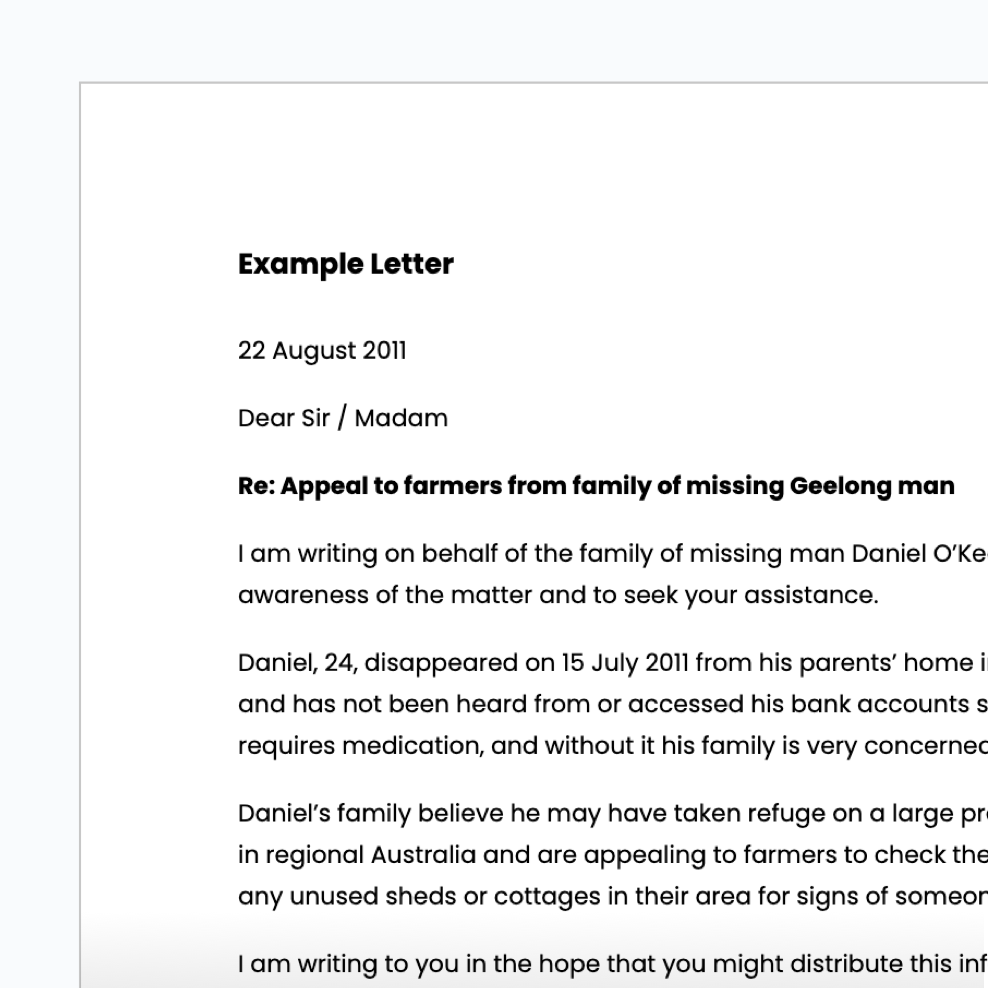
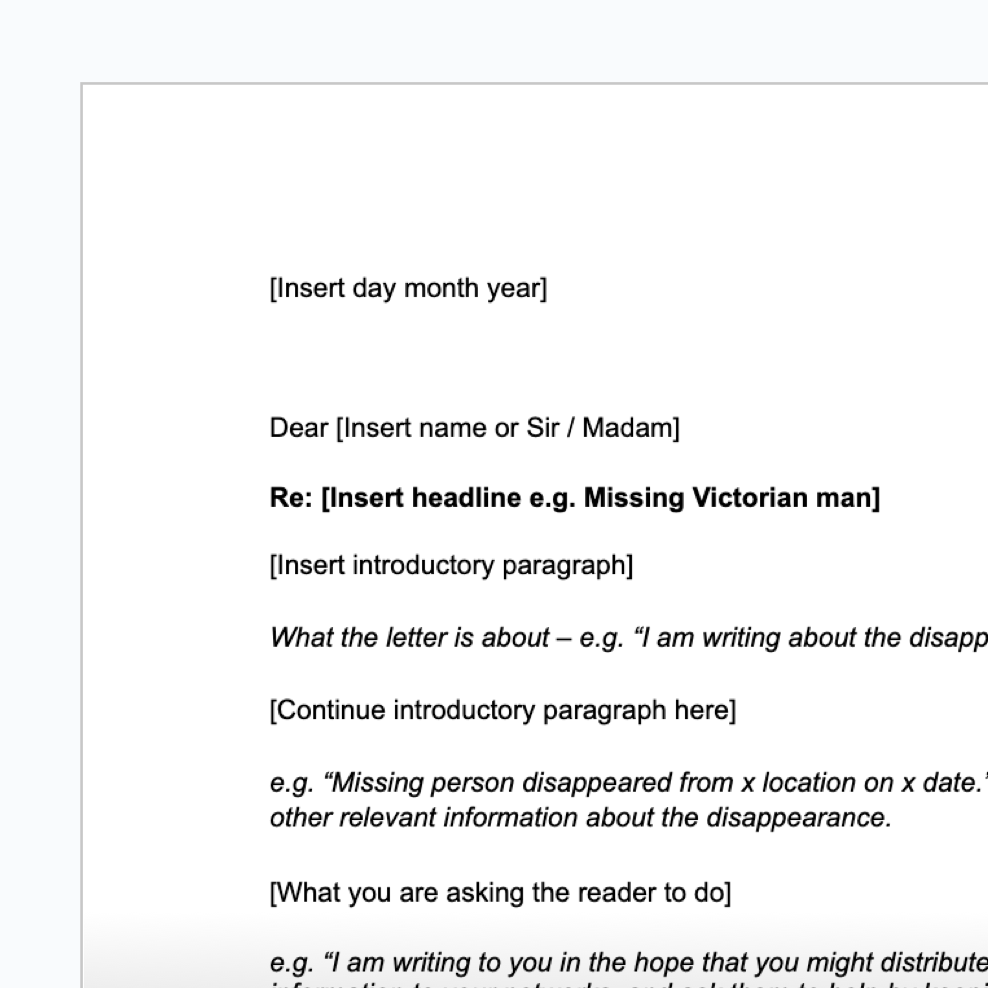
A well-connected individual is invaluable when searching for a loved one. It might be worth writing a letter (or personalised email) to a local figure or organisation to assist in your search. They might be able to help by passing on your missing person’s picture or information to their networks, or displaying your missing loved one’s poster. Letters are more formal than emails or direct messages and thus can have more impact.
Organisations/people you could send a letter to could include:
- State and federal MPs
- Local figures/celebrities
- Homeless shelters
- Country Women’s Associations
- RSL clubs
- Fruit picking employers
- Trucking companies
- Hare Krishna groups
- Salvation Army locations
- Bushwalking clubs
The contact details of many of the above can be found on the Contacts page.
It’s a good idea to get another person to read the appeal before you send it.
Tips
- Ask for help with your mailout – e.g. if you want to send a letter to all Victorian homeless shelters, ask someone to help you find the contact details to save time (there may be many shelters thus many appeals to send)
- Email the letter wherever possible
- Attach a copy of the poster
- Always include the link to the Facebook page / social page / or website (if applicable) in your letter
- Write in short paragraphs and simple sentences
- Make sure you are clear in what you are asking the reader to do e.g. to display the poster in their window / to pass the information of your missing person on to their networks etc.
- Think about how far you want to send your letter e.g. do you want to send it to RSL clubs in your local area, your state, or the whole country
- People who receive your letter may respond and offer condolences, or offer their help or support.
Resources

Information channels
Crime Stoppers is the default national line to report sightings of missing persons, but you may want a more direct approach.
Direct contact with the public
The advantage of setting up direct information channels is that you cut out the middlemen (Crime Stoppers volunteers and police), which minimises delay. You know the missing person better than police so you are able to prioritise which calls and possible sightings are worth following up. Take note of the details of enquiries/information received and forward them to the police officer working on your case if you feel the information is worth investigating.
Setting up a hotline phone
Setting up a hotline is relatively cheap and easy; all you will need to get is a handset, sim card and some prepaid credit. You will also need to publicise the number so that people know to call it. Some tips on setting up a hotline include:
- Keep the hotline separate to your personal mobile number.
- Update your communications (posters, social media etc.) with details of the number.
- Promote the immediacy of the hotline (urging the public to contact you directly via the hotline if their information is urgent).
- Write and send out a media release when the hotline is activated. See: Traditional media
Setting up a website
Setting up a website is relatively cheap and easy. Wix, Squarespace and GoDaddy offer simple website builders. Some tips include:
- Keep the url as short and customised as possible (e.g. missingmaria.com).
- Update your communications (posters, social media etc.) with the website’s url.
- Promote the directness of the website (urging the public to contact you directly via a form within the website).
- Write and send out a media release when the website is live. See: Traditional media
Setting up an email and PO Box
Creating a dedicated email address and PO Box is easy and helps organise all incoming information. Some tips include:
- Use an email separate from your personal account.
- Link the email to social media accounts, and allow trusted others access to assist with management if needed.
- Consider a PO Box for anonymous submissions and to keep sensitive mail away from your home address.
Considerations
Setting up direct contact with the public is a big commitment. You’ll need to be prepared to liaise with members of the public and to manage the emotions that go with hearing news of sightings and possible sightings. You should consider sharing the responsibility with a small group of friends or family to avoid additional mental exhaustion. Having public contact channels can also make you a target for hoaxes and pranks, so keep your wits about you.
Psychic insights are very common in missing persons cases, and you should decide whether you are open to receiving them. On rare occasions, genuine information may come through under the guise of a psychic insight. If possible, set up a separate channel for these reports and allocate someone to assess them for credibility and identify recurring themes. Be aware that such reports often take up considerable time with little benefit and can be distressing to read.